

Search all blogs
Latest posts
-
 Guide to Green Polyester Tape10/09/2026Read more
Explore our Green Polyester Tape range for high temperature masking with 80 stocked sizes, 40 widths and 25 or 80...
-
 Conveyor Feet Guide: Types, Materials & Installation03/07/2026Read more
Everything you need to know about conveyor feet, types, load ratings, materials, installation steps and how...

Metric Coarse Thread vs Fine Thread: An Engineer's Guide
Metric Coarse Thread vs Metric Fine Thread
When selecting fasteners for engineering projects, understanding the fundamental differences between metric coarse thread and metric fine thread is crucial for ensuring optimal performance safety and reliability.
This guide explains the key distinctions applications and selection criteria for both thread types in UK engineering and manufacturing.
Key insight
The primary difference between coarse vs fine thread lies in the pitch which is the distance between thread peaks. Metric coarse threads have larger pitches for faster assembly whilst fine threads offer superior strength and precision for demanding applications.
Understanding metric thread fundamentals
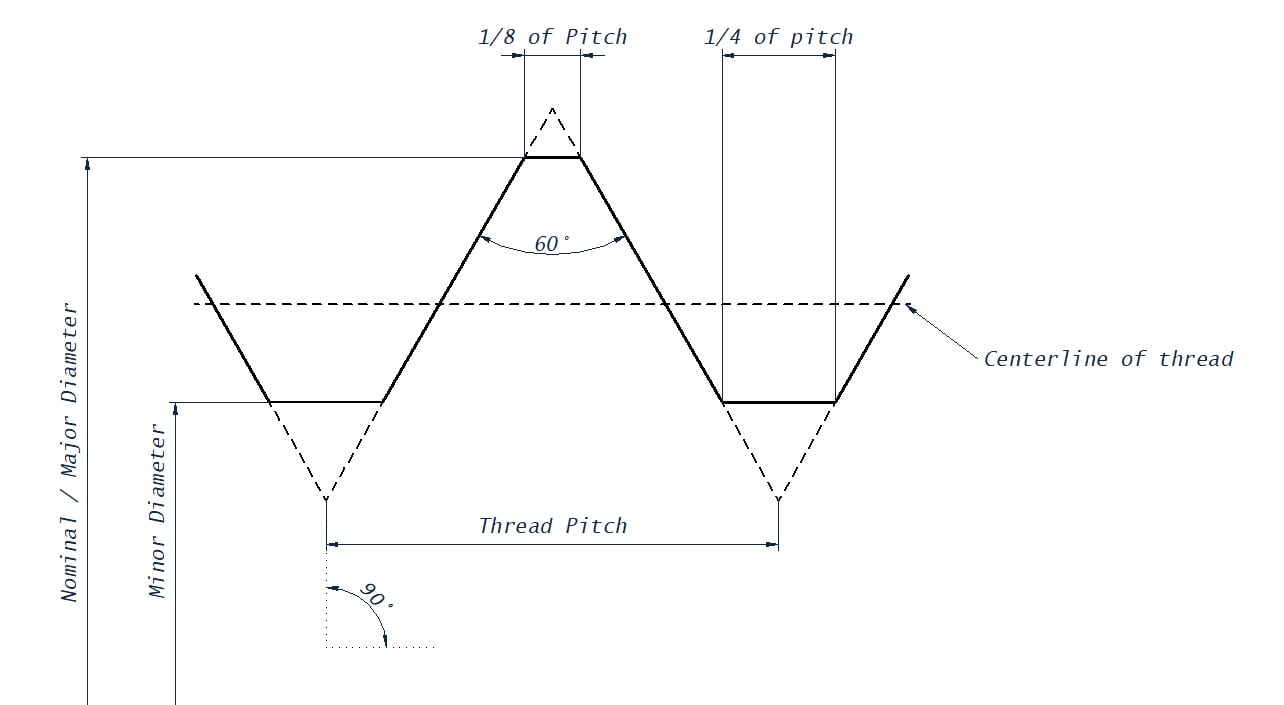
Metric threads follow the ISO 68-1 standard. Both metric thread coarse vs fine variants share a characteristic 60° V-shaped profile which supports compatibility across global manufacturing standards.
Coarse threads are the default pitch for each diameter size. Fine threads use a smaller pitch and are always specified in the designation.
Thread profile
Metric threads are shaped as a 60° V profile which helps distribute load consistently and ensures standardised fit across compatible fasteners.
Metric coarse thread characteristics
Metric coarse thread is the standard pitch series for each diameter. If a thread is designated simply as M10 it typically refers to the coarse pitch variant such as M10 × 1.5.
- Larger pitch spacing: greater distance between thread peaks
- Faster assembly: fewer turns required to install
- Enhanced durability: thicker roots resist stripping
- Superior dirt resistance: wider valleys tolerate contamination
- Cost-effective manufacturing: standard tooling and production
Metric fine thread characteristics
Fine threads have smaller pitch dimensions and are always specified in the designation for example M10 × 1.25. A fine thread vs coarse thread comparison highlights improved strength and precision.
- Smaller pitch spacing: more threads per unit length
- Increased strength: larger stress area and minor diameter
- Vibration resistance: reduced tendency to loosen
- Precision adjustment: finer incremental movement
- Reduced torque requirements: less force for equivalent preload
Metric thread 60° V-shape diagram
Metric threads share the same standard profile which ensures compatibility and predictable engagement across fasteners and tapped holes.
Comprehensive comparison: coarse vs fine thread
| Characteristic | Metric coarse thread | Metric fine thread |
|---|---|---|
| Assembly speed | Faster installation and removal | Slower requires more rotations |
| Tensile strength | Good for general applications | Superior strength per diameter |
| Vibration resistance | More prone to loosening | Excellent vibration resistance |
| Dirt tolerance | Better contamination resistance | More susceptible to debris |
| Manufacturing cost | Lower tooling and production costs | Higher precision manufacturing required |
| Thread stripping | Less likely to strip or cross-thread | More susceptible to damage |
| Precision applications | Suitable for general positioning | Ideal for fine adjustments |
| Thin-wall applications | May cause splitting in thin materials | Excellent for thin-walled components |
Metric coarse thread specifications
The table below lists standard metric coarse thread dimensions used across common engineering applications.
| Thread size | Major diameter (mm) | Pitch (mm) | Recommended tap drill (mm) | Minor diameter male (mm) | Minor diameter female (mm) |
|---|---|---|---|---|---|
| M1 | 1.0 | 0.25 | 0.75 | 0.693 | 0.729 |
| M1.1 | 1.1 | 0.25 | 0.85 | 0.793 | 0.829 |
| M1.2 | 1.2 | 0.25 | 0.95 | 0.893 | 0.929 |
| M1.4 | 1.4 | 0.3 | 1.1 | 1.032 | 1.075 |
| M1.6 | 1.6 | 0.35 | 1.25 | 1.171 | 1.221 |
| M1.8 | 1.8 | 0.35 | 1.45 | 1.371 | 1.421 |
| M2 | 2.0 | 0.4 | 1.6 | 1.509 | 1.567 |
| M2.2 | 2.2 | 0.45 | 1.75 | 1.648 | 1.713 |
| M2.5 | 2.5 | 0.45 | 2.05 | 1.948 | 2.013 |
| M3 | 3.0 | 0.5 | 2.5 | 2.387 | 2.459 |
| M3.5 | 3.5 | 0.6 | 2.9 | 2.764 | 2.85 |
| M4 | 4.0 | 0.7 | 3.3 | 3.141 | 3.242 |
| M4.5 | 4.5 | 0.75 | 3.8 | 3.58 | 3.688 |
| M5 | 5.0 | 0.8 | 4.2 | 4.019 | 4.134 |
| M6 | 6.0 | 1.0 | 5.0 | 4.773 | 4.917 |
| M8 | 8.0 | 1.25 | 6.8 | 6.466 | 6.647 |
| M10 | 10.0 | 1.5 | 8.5 | 8.16 | 8.376 |
| M12 | 12.0 | 1.75 | 10.2 | 9.853 | 10.106 |
| M16 | 16.0 | 2.0 | 14.0 | 13.546 | 13.835 |
| M20 | 20.0 | 2.5 | 17.5 | 16.933 | 17.294 |
| M24 | 24.0 | 3.0 | 21.0 | 20.319 | 20.752 |
| M30 | 30.0 | 3.5 | 26.5 | 25.706 | 26.211 |
| M36 | 36.0 | 4.0 | 32.0 | 31.093 | 31.67 |
| M42 | 42.0 | 4.5 | 37.5 | 36.479 | 37.129 |
| M48 | 48.0 | 5.0 | 43.0 | 41.866 | 42.857 |
| M56 | 56.0 | 5.5 | 50.5 | 49.252 | 50.046 |
| M60 | 60.0 | 5.5 | 54.5 | 53.252 | 54.046 |
Metric fine thread specifications
Fine thread dimensions are commonly used where enhanced strength precision and vibration resistance are required.
| Thread size | Major diameter (mm) | Pitch (mm) | Recommended tap drill (mm) | Minor diameter male (mm) | Minor diameter female (mm) |
|---|---|---|---|---|---|
| M1.0 × 0.2 | 1 | 0.2 | 0.8 | 0.755 | 0.783 |
| M1.1 × 0.2 | 1.1 | 0.2 | 0.9 | 0.855 | 0.883 |
| M1.2 × 0.2 | 1.2 | 0.2 | 1 | 0.955 | 0.983 |
| M1.4 × 0.2 | 1.4 | 0.2 | 1.2 | 1.155 | 1.183 |
| M1.6 × 0.2 | 1.6 | 0.2 | 1.4 | 1.355 | 1.383 |
| M2 × 0.25 | 2 | 0.25 | 1.75 | 1.693 | 1.729 |
| M3 × 0.35 | 3 | 0.35 | 2.6 | 2.571 | 2.621 |
| M4 × 0.5 | 4 | 0.5 | 3.5 | 3.387 | 3.459 |
| M5 × 0.5 | 5 | 0.5 | 4.5 | 4.387 | 4.459 |
| M6 × 0.75 | 6 | 0.75 | 5.2 | 5.08 | 5.188 |
| M8 × 1.0 | 8 | 1 | 7 | 6.773 | 6.917 |
| M10 × 1.25 | 10 | 1.25 | 8.8 | 8.466 | 8.647 |
| M12 × 1.25 | 12 | 1.25 | 10.8 | 10.466 | 10.647 |
| M14 × 1.25 | 14 | 1.25 | 12.8 | 12.466 | 12.647 |
| M16 × 1.5 | 16 | 1.5 | 14.5 | 14.16 | 14.376 |
| M18 × 1.5 | 18 | 1.5 | 16.5 | 16.16 | 16.376 |
| M20 × 2.0 | 20 | 2 | 18 | 17.546 | 17.835 |
| M22 × 2.0 | 22 | 2 | 20 | 19.546 | 19.835 |
| M24 × 1.5 | 24 | 1.5 | 22.5 | 22.16 | 22.376 |
Industry applications and selection guidelines
Metric coarse thread applications
Metric coarse thread fasteners suit applications where speed cost and contamination tolerance are priorities.
- Construction and structural work: frameworks steel structures heavy installations
- General manufacturing: faster production line assembly
- Automotive body panels: non-critical fastening
- Woodworking and carpentry: reduced splitting risk
- Maintenance and repair: better tolerance to dirt and wear
Fine thread applications
Fine threads are often selected when strength vibration resistance and precise adjustment matter most.
- Automotive engines: vibration-critical components
- Aerospace components: high safety and performance requirements
- Precision machinery: machine tools and inspection equipment
- Hydraulic systems: high-pressure sealing applications
- Thin-walled components: improved engagement with less splitting
Decision framework
Choose metric coarse thread for general applications prioritising assembly speed and cost. Select fine threads for precision higher strength and vibration-critical assemblies.
Material considerations
- Brittle materials: coarse threads reduce cracking risk in plastics and composites
- Hard metals: fine threads can offer stronger engagement and smoother preload
- Thin sections: fine threads provide better engagement without weakening
- Standard steels: either thread type can work depending on vibration and load requirements
Environmental factors
- High vibration: fine threads offer improved resistance to loosening
- Contamination: coarse threads tolerate dirt and debris better
- Precision requirements: fine threads enable accurate positional control
- Temperature cycling: fine threads can help maintain preload under thermal change
Frequently asked questions
ISO standards and compliance
Metric threads are standardised which supports interchangeability across UK and international supply chains.
- ISO 68-1: Basic profile and dimensions for metric threads
- ISO 261: Standard combinations of diameter and pitch
- ISO 965-1: Tolerance specifications for general-purpose threads
- ISO 724: Basic dimensions for metric screw threads
Expert recommendations
- Start with application needs: speed strength precision and serviceability
- Assess vibration risk: fine threads can help reduce loosening tendencies
- Consider contamination: coarse threads handle dirt better in real-world conditions
- Match materials correctly: thin sections often benefit from fine thread engagement
- Plan maintenance: consider accessibility and likelihood of cross-threading
For complex assemblies or critical applications consult a fastener specialist to confirm the best thread choice for your specific requirements.
Got a question? Need some help?
Our friendly Product Support Team are here to help, so please just give us a call if we can assist you with sourcing standard and custom parts.
CALL USRelated posts
-
 Stainless Steel Equivalent GradesCompare stainless steel grades and find the perfect match for your next project.Read more
 -
 Stainless Steel Fasteners: Tightening and Breaking TorquesUnderstanding the Limits: How to Properly Tighten Stainless Steel Fasteners Without Compromising Strength or...Read more
 -

Leave a comment