



































































Search all blogs
Latest posts
-
 Metal Fastener Crossword – Test Your Fastener Knowledge27/10/2026Read more
Test your knowledge with our metal fastener crossword featuring bolts, nuts, screws, washers, threads and...
-
 How to Choose the Right Fastener GUIDE27/10/2026Read more
Learn how to choose the right fastener for your application. Compare screws, bolts, nuts, washers, materials,...
Complete Guide to Grub Screws
Complete Guide to Grub Screws
Grub screws are compact, headless fasteners used across engineering, manufacturing, automotive and mechanical applications.
This guide explains what grub screws are, how they work, the different point styles available, common metric sizes, DIN and ISO standards, materials and how to choose the correct grub screw for your application.
What Is a Grub Screw?
A grub screw is a headless threaded fastener designed to be driven completely or partially into a threaded hole. Rather than using a conventional screw head to clamp two components together, the point of the grub screw applies pressure directly against a shaft, surface or mating component.
Most socket grub screws are installed using an Allen or hex key while slotted grub screws use a conventional slotted driver.
Because there is no protruding head, grub screws are particularly useful where space is limited or where a flush installation is required.
Explore our complete range of Grub Screws including socket and slotted designs in a selection of metric sizes, materials and point styles.

Shop Grub Screws
Are Grub Screws and Set Screws the Same?
The terminology can vary depending on the fastener standard and region. Grub screws are commonly referred to as set screws or socket set screws, particularly when describing headless fasteners used to secure one component against another.
When selecting a fastener, it is more useful to check the point style, drive type, thread size, material and DIN or ISO standard rather than relying on the name alone.
How Do Grub Screws Work?
A grub screw is threaded into a tapped hole until its point makes contact with the mating component. Tightening the screw creates pressure between the two components, helping prevent unwanted movement.
The way this pressure is applied depends heavily on the grub screw point style.
A cup point can bite into the surface for strong general-purpose holding while a flat point spreads the load across a larger contact area. Cone points concentrate force into a smaller area while dog points can locate into a matching hole or slot.
What Are Grub Screws Used For?
Grub screws are used where components need to be located, secured or prevented from moving without the fixing head projecting from the assembly.
The most suitable grub screw depends on the mating material, required holding force, whether the component needs to be repositioned and whether marking the mating surface is acceptable.
Types of Grub Screws
One of the most important decisions when choosing a grub screw is the point style. Different point designs change how the screw contacts and grips the mating component.
 DIN 913 / ISO 4026
Flat Point Grub Screws
Flat point grub screws have a flat contact surface that distributes pressure across a wider area.
They are useful where excessive indentation or damage to the mating surface should be avoided and where the grub screw is tightened against a flat surface.
Best suited for: applications requiring a larger contact area and reduced surface marking.
 DIN 914 / ISO 4027
Cone Point Grub Screws
Cone point grub screws taper to a defined point, concentrating the fixing force into a smaller contact area.
The point can locate into an existing indentation or create an indentation in a softer mating material, helping provide strong resistance to movement.
Best suited for: strong location and holding power where surface marking is acceptable.
 DIN 915 / ISO 4028
Dog Point Grub Screws
Dog point grub screws feature an extended cylindrical tip rather than a conventional flat or pointed end.
The dog point can locate into a corresponding hole or slot, making this style particularly useful for accurately locating components or controlling movement.
Best suited for: locating, indexing, shafts, gears and moving components.
 DIN 916 / ISO 4029
Cup Point Grub Screws
Cup point grub screws have a concave end surrounded by a raised circular edge.
This edge concentrates contact around the outside of the point and provides good gripping capability against the mating surface.
Best suited for: general-purpose fastening where strong grip against a shaft or component is required.
Slotted Flat, Cone and Cup Point Grub Screws
Slotted grub screws use a conventional screwdriver slot instead of an internal hex socket. The point style still determines how the grub screw contacts the mating surface.
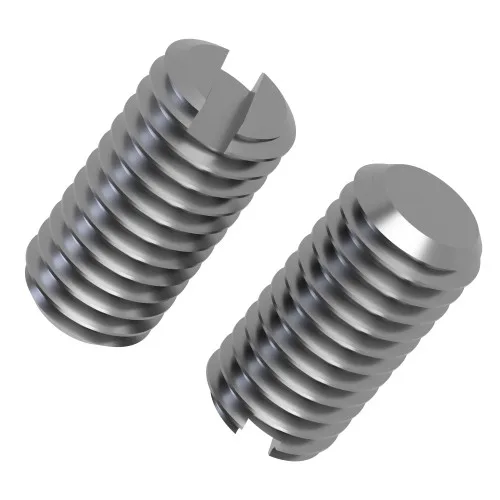
Slotted Flat Point
DIN 551
Broad contact with a flat mating surface and conventional slotted installation.
Shop Slotted Flat Point
Slotted Cone Point
DIN 553
Concentrated point for positive location where a slotted drive is preferred.
Shop Slotted Cone Point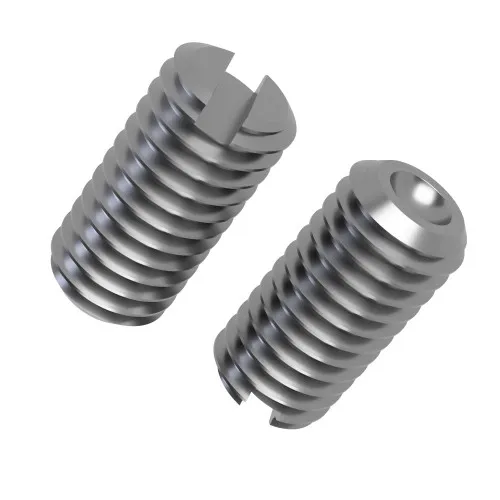
Slotted Cup Point
DIN 438
General-purpose gripping point with a conventional slotted drive.
Shop Slotted Cup PointGrub Screw Selection Table
Use the table below to compare the main point styles and identify which grub screw may be most suitable for your application.
| Grub Screw Type | Standard | Point Style | Typical Application |
|---|---|---|---|
| Socket Flat Point | DIN 913 / ISO 4026 | Flat | Larger contact area and reduced marking |
| Socket Cone Point | DIN 914 / ISO 4027 | Cone | Strong location and high holding force |
| Socket Dog Point | DIN 915 / ISO 4028 | Extended Cylindrical Point | Locating into holes or slots |
| Socket Cup Point | DIN 916 / ISO 4029 | Cup | General-purpose grip and shaft fixing |
| Slotted Flat Point | DIN 551 | Flat | Broad contact with slotted installation |
| Slotted Cone Point | DIN 553 | Cone | Positive location with slotted installation |
| Slotted Cup Point | DIN 438 | Cup | General-purpose slotted fixing |
How to Choose the Right Grub Screw
Choosing the correct grub screw involves more than simply matching the diameter of the threaded hole.
Point Style
Choose flat, cone, cup or dog point depending on how the screw needs to contact the mating component.
Thread Size
The grub screw thread must match the internal thread of the component it is being installed into.
Length
Select a length that provides suitable thread engagement and allows the point to contact the mating component correctly.
Drive Type
Socket grub screws use an Allen or hex key while slotted designs use a compatible slotted driver.
Material
Consider the required strength and corrosion resistance for the operating environment.
Mating Surface
Consider whether marking or indentation is acceptable. Cone and cup points may grip more aggressively than flat points.
Grub Screw Sizes and Dimensions
Metric grub screw sizes are normally identified by their thread diameter and length.
M4 = nominal metric thread diameter
10mm = grub screw length
Common searches include M3, M4, M5, M6 and M8 grub screws although the sizes available depend on the point style, standard and material selected.
If replacing an existing grub screw, measure the thread diameter and overall length and confirm the thread pitch before ordering a replacement.
Check These Measurements
- Thread diameter
- Thread pitch
- Overall screw length
- Available threaded depth
- Required thread engagement
- Point style
- Drive size
Grub Screw DIN and ISO Standards Explained
DIN and ISO standards help define the geometry and dimensions of commonly used grub screw designs.
| Point Style | DIN Standard | ISO Standard |
|---|---|---|
| Flat Point | DIN 913 | ISO 4026 |
| Cone Point | DIN 914 | ISO 4027 |
| Dog Point | DIN 915 | ISO 4028 |
| Cup Point | DIN 916 | ISO 4029 |
DIN 913, DIN 914, DIN 915 and DIN 916 have corresponding ISO standards so you may encounter either designation when identifying or replacing an existing fastener.
Slotted grub screw standards within our range include DIN 551 flat point, DIN 553 cone point and DIN 438 cup point.
What Materials Are Grub Screws Available In?
Our grub screw range includes options manufactured from A1 Stainless Steel, A2 Stainless Steel, Marine Grade A4 Stainless Steel and Class 45H Steel BZP depending on the grub screw type and size selected.
A1 Stainless Steel
A1 Stainless Steel provides corrosion resistance for a range of general fastening applications.
A2 Stainless Steel
A2 Stainless Steel is a widely used corrosion-resistant material suitable for many general engineering, manufacturing and indoor or outdoor applications.
Marine Grade A4 Stainless Steel
Marine Grade A4 Stainless Steel provides increased corrosion resistance and is commonly selected for more demanding environments.
Class 45H Steel BZP
Class 45H Steel provides high hardness while the bright zinc plated finish adds a protective zinc coating to the steel surface.
Material availability varies by DIN standard, point style and size so always check the individual product specification before ordering.
How to Remove a Grub Screw
Most grub screws can be removed using the same drive used during installation. Before attempting removal, make sure the tool is the correct size and fully engaged with the drive.
Clean the Drive
Remove debris, dirt and corrosion from the socket or slot.
Use the Correct Tool
Insert the correct Allen key, hex key or screwdriver fully into the drive.
Turn Anti-Clockwise
Apply steady and controlled anti-clockwise pressure.
Avoid Undersized Tools
Using an undersized tool can round or damage the drive.
How to Remove a Stuck or Seized Grub Screw
- Remove dirt, corrosion or debris from around the fixing.
- Apply a suitable penetrating lubricant and allow time for it to work.
- Use the correct driver and apply controlled pressure.
- Avoid excessive force that could round the socket or damage the surrounding component.
How to Remove a Stripped Grub Screw
A damaged socket or drive makes removal more difficult.
Depending on the application and accessibility, options can include carefully creating a new drive surface or using a suitable screw extractor.
Drilling should generally be treated as a later option because of the risk of damaging the surrounding thread or component.
Where the fixing forms part of valuable or safety-critical equipment, professional removal may be preferable to risking damage to the assembly.
Grub Screw FAQs
Need Grub Screws?
Browse flat point, cone point, dog point, cup point, socket and slotted grub screws in a selection of metric sizes, DIN standards and materials.
Related posts
-
 The Complete Guide to Wing nutsEverything you need to know about wing nuts: uses, types, and expert tips for every project.Read more
-
 Guide to Hose Clamps: Types, Grades and Common ApplicationsDiscover materials, clamp types (W2–W5) and ideal uses from worm‑drive to T‑boltRead more
-
 A Guide to Stainless Steel Levelling Feet: Heavy Duty Adjustable Solutions for UK IndustryEverything you need to know about selecting, measuring & installing levelling feet for equipment stabilityRead more
Leave a comment