




























































































Calculate torque using force and distance.
How Torque Works
Torque is a rotational effect that causes an object to rotate around a pivot point. It depends on the magnitude of the force, the distance from the pivot and the angle at which the force is applied.
Formula Breakdown
Common Torque Calculations
The following examples assume the force is applied perpendicular to the lever arm at 90°.| Force | Lever Arm | Angle | Torque |
|---|---|---|---|
| 25N | 0.5m | 90° | 12.50N·m |
| 50N | 0.5m | 90° | 25.00N·m |
| 100N | 0.25m | 90° | 25.00N·m |
| 100N | 0.5m | 90° | 50.00N·m |
| 100N | 1m | 90° | 100.00N·m |
| 150N | 0.4m | 90° | 60.00N·m |
| 200N | 0.5m | 90° | 100.00N·m |
How Angle Affects Torque
The direction of the force affects how much torque is generated.
| Angle | Decimal | Torque |
|---|---|---|
| 0° | 0 | 0.00N·m |
| 30° | 0.5 | 25.00N·m |
| 45° | 0.707 | 35.36N·m |
| 60° | 0.866 | 43.30N·m |
| 90° | 1 | 50.00N·m |
Calculated Torque Is Not Recommended Fastener Tightening Torque
This calculator determines the torque generated by an applied force acting at a known distance and angle.
It does not necessarily determine the correct tightening torque for a bolt, screw or other threaded fastener.
Recommended fastener tightening torque can depend on:
How to Measure the Lever Arm
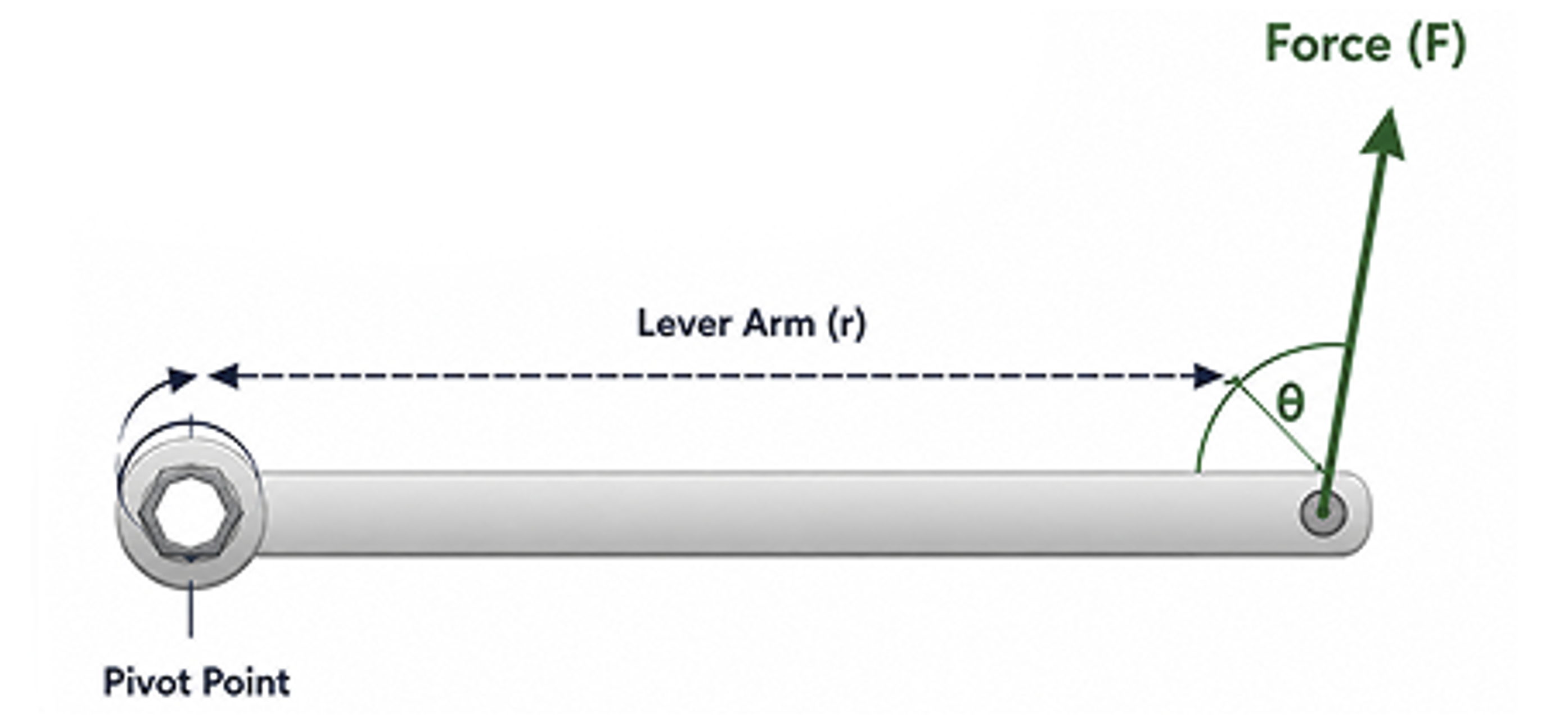
If you are using the Torque Calculator with a tool such as a spanner, wrench or lever, measure the distance between the centre of the pivot point and the position where the force is being applied.
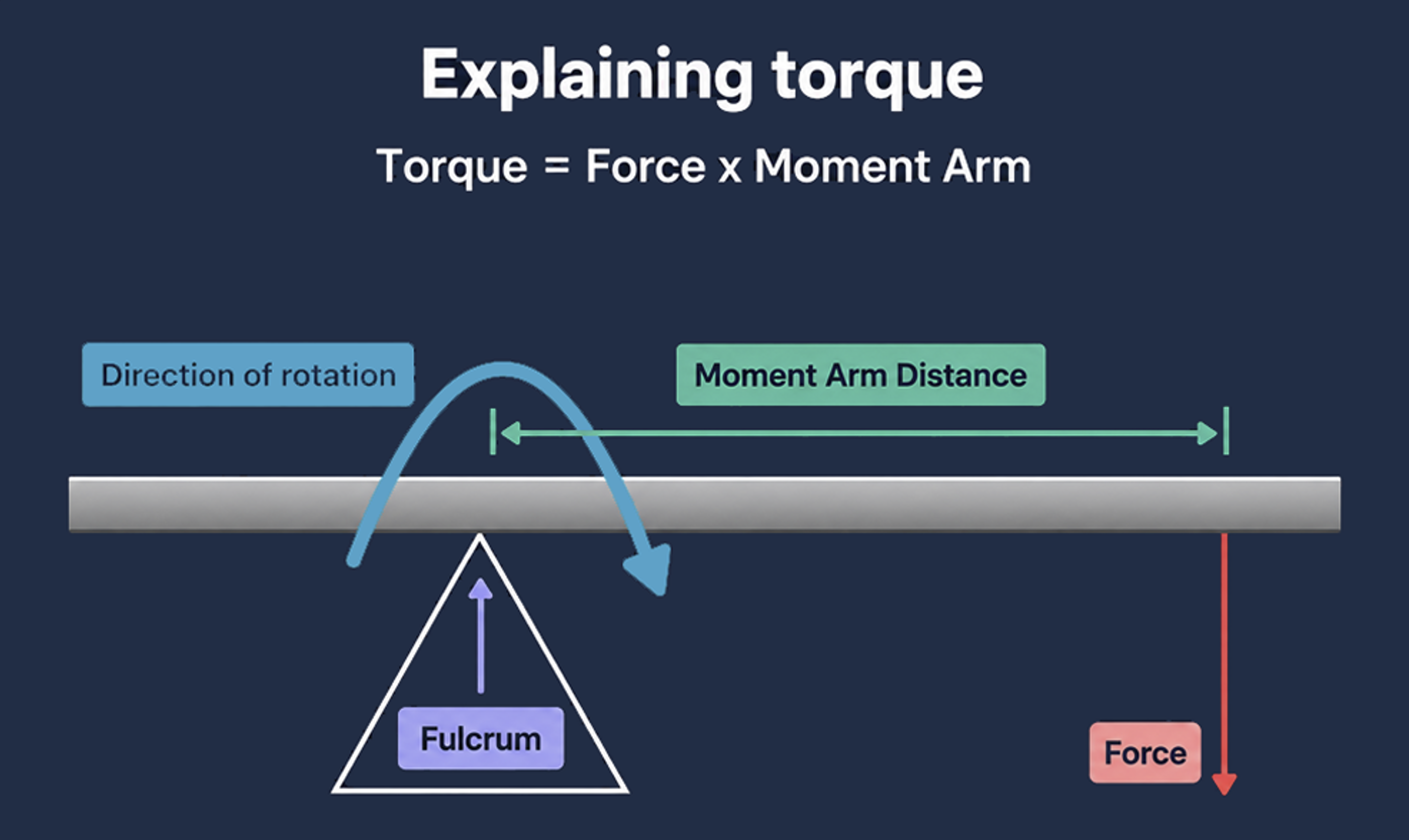
Torque is created when a force acts at a distance from a pivot point.
For example, when using a spanner, the fastener acts as the pivot, the length of the spanner provides the lever arm and the force applied to the handle creates the turning effect.
The further away from the pivot the force is applied, the greater the potential torque.
The angle at which the force acts also affects the result, with maximum torque being generated when the force is applied at 90° to the lever arm.
Calculate TorqueTorque and Fasteners
Torque is commonly associated with bolts, screws, nuts and other threaded fasteners because rotational force is required during installation and removal.
However, calculating the mechanical torque generated by a force is different from determining the recommended installation torque for a particular fastener.
Fastener tightening requirements can vary significantly depending on the fastener specification and application.
If you need help selecting the correct bolt, screw, washer or other fastening component, our Technical Team can provide product guidance.
Get Technical AdviceHow Does the Torque Calculator Work?
Torque describes the turning effect produced when a force acts around a pivot, fulcrum or rotational axis.
The amount of torque produced depends on the force being applied, the distance between the pivot and the point where the force is applied and the angle of the applied force.
Applying more force or applying the force further away from the pivot generally produces more torque.
The angle is also important because only the component of the force acting perpendicular to the lever arm contributes fully to rotation.Related Engineering Tools
Continue your calculation using our other fastener and engineering tools.
Convert between Threads Per Inch (TPI) and metric thread pitch.
Use CalculatorConvert fastener dimensions between millimetres and inches.
Use CalculatorFind suitable washer dimensions based on your bolt or screw size.
Use CalculatorCalculate recommended pilot hole sizes for hardwood and softwood.
Use CalculatorTorque Calculator FAQs
Common questions about force, lever arms, angles and torque calculations.The amount of torque produced depends on the force being applied, the distance between the pivot and the point where the force is applied, and the angle of the applied force.
Torque is calculated using:
Torque = Force × Lever Arm × sin(Angle)
Applying more force or applying the force further away from the pivot generally produces more torque.
The angle is also important because only the component of the force acting perpendicular to the lever arm contributes fully to rotation.
Within the torque calculation, force is represented by:
F
and is measured in:
Newtons (N)
For example:
Force = 100N
If the lever arm and angle remain unchanged, increasing the applied force will increase the resulting torque.
For example, at a lever arm of 0.5m and an angle of 90°:
50N = 25N·m
100N = 50N·m
200N = 100N·m
Within the torque calculation, the lever arm is represented by:
r
and is measured in:
Metres (m)
A longer lever arm allows the same amount of force to generate more torque.
For example, using a force of 100N at 90°:
0.25m lever arm = 25N·m
0.5m lever arm = 50N·m
1m lever arm = 100N·m
This is why a longer spanner or wrench can make it easier to turn a fastener.